

Recognition
Recognition you can hand to someone who will check it.
A profile prepared to the standard this publication holds: every claim tied to a dated source, written by an editor, approved by a second one, and correctable for as long as it stands.
What it means
A record, not a verdict.
Recognition here is a published profile and, where the facts support one, a release in the subject's name. Both are assembled only from claims an editor has recorded against a source, with the date that source was read.
Alongside them a recognised professional may be included in the printed edition, and receives a certificate and an engraved award. Those objects record that a profile was prepared to this standard and published. They are not a ranking, a qualification or a licence, they confer no letters after anybody's name, and they do not say that one professional is better than another.
The publication documents standing that already exists in the record. It does not create standing.
What is issued
Recognition you can hand to someone.
The profile is the whole of the editorial work. These are what a recognised professional holds once it is published.
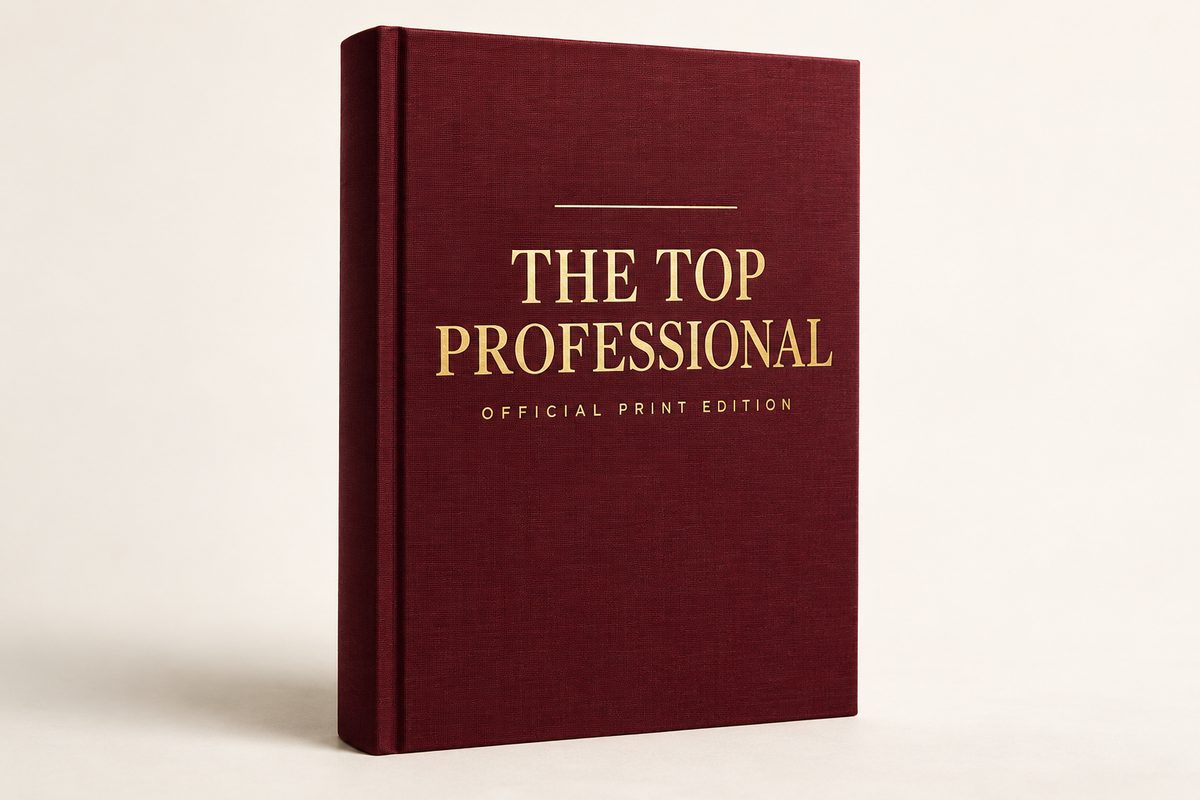
The annual print edition.
Profiles selected for the printed edition appear as they do on the site: the same sentences, resting on the same recorded sources, set for the page.

A certificate of recognition.
Mounted on a piano finish plaque and engraved with the subject’s name and the date their profile was published. It records that the work was done to this standard. It is not a qualification or a licence.

An engraved optical crystal.
A faceted crystal carrying the publication’s name, engraved to order. Like the certificate, it marks that the record was made. It confers nothing the record does not already show.
Product images are representations. Items are engraved to order and the finish may vary from the images shown.
Who can be considered
Anyone whose work leaves a trail.
-
A public record
A register entry, a licence, a filing, a published study, a patent, an employer page: something an editor can read and date.
-
Work to describe
A role, a field and a body of practice. The profile is about what somebody does, not about how they are regarded.
-
Consent
Publishing a profile, issuing a release, generating a likeness and running a contact form are four separate permissions, each recorded.
-
Willingness to be corrected
A subject who wants a claim published that no source supports is not a candidate for this publication.
How consideration works
From enquiry to published profile.
-
01
Enquiry
You tell us who the subject is and where their work is on the record. No payment is taken at this stage and none is asked for.
-
02
Review
An editor looks for sources. If the record will not carry a profile, we say so and stop. This is the step that decides, and it comes before any commercial conversation.
-
03
Terms
Only once a subject qualifies is scope agreed and anything invoiced. Payment never precedes qualification.
-
04
Preparation
Sources are recorded and dated, claims are extracted one at a time, and a draft is assembled in which every sentence declares what it rests on.
-
05
Publication
A second editor approves it, the profile publishes with its sources beneath it, and it stays correctable.
What is and is not assessed
Nothing here is scored.
-
No ranking
Profiles are not ordered by merit and carry no score, grade or position. The directory is alphabetical.
-
No comparison
Nothing published implies that a listed professional is better than one who is not listed, or than another who is.
-
No endorsement
A profile records what sources say. It is not a recommendation, a referral or a judgement of quality.
What the professional receives
What is actually delivered.
-
A profile
A permanent page at its own address, with sources numbered, dated and printed beside the text.
-
A release
Where the facts support one, a dated release in the subject’s name, held to the same sourcing rules.
-
A link worth sending
An address that can be put on a signature, a bio or a bid, and that stands up when somebody checks it.
-
A standing correction route
The record can be corrected for as long as it is published, against the source rather than against opinion.
The commercial relationship
What payment does and does not buy.
Where a professional pays, they are paying for the work of preparing and publishing a profile: the research, the recording of sources, the drafting, the editorial review and the hosting of the page.
They are not paying for the assessment inside it. No payment adds a claim, removes a source, softens a disputed entry or changes what a source says. A subject who qualifies and pays gets a profile. A subject who pays and does not qualify gets told so, and does not get a profile.
Because of that, nothing on this site should be read as an independent ranking of the professionals listed on it. It is an edited record, published to a standard, and the standard is the thing being offered.
Request
Start with the sources.
Enquiries are handled by the editorial desk. The address is published on the About page alongside the corrections and editorial routes.
No payment changes what a source says.